
11 hr
Nagoya Day Trip: Gujo Hachiman, Takayama & Shirakawa-go
Discover three historic Japanese villages on this full-day journey through Gifu Prefecture's heritage sites
Reserve
Hand-picked by our editors — only the best 5 experiences from 14 reviewed.
Verified partners for every tour, free cancellation where available, and instant confirmation on every booking.
11 hr
Discover three historic Japanese villages on this full-day journey through Gifu Prefecture's heritage sites
Reserve
4 hr
Independent exploration of a UNESCO village aboard direct express coaches with flexible departure points
Reserve
9 hr
Journey to historic mountain towns with a licensed guide, private car, and flexible itinerary tailored to you
ReservePrices from verified partners. Availability updates in real time at checkout. Free cancellation policies apply where shown.
The landmarks, rooms, and views travelers on this tour remember — all visible on a single visit.
The largest farmhouse in the village, built in the Edo period and designated an Important Cultural Property.
A unique temple complex with a thatched-roof bell tower and a 400-year-old yew tree.
Offers a clear perspective of the entire valley and the village layout below.
Built in 1890, this five-story structure highlights the history of silkworm cultivation in the region.
The primary pedestrian bridge connecting the village to the main parking area.
Private transport offers tailored convenience, while the public highway bus is the most cost-effective way to reach this UNESCO heritage site. They complement each other; most visitors who do both call the nagoya to shirakawago private tour the more comfortable option for Gifu exploration.
| Feature | Top pick Private Tour | Public Highway Bus |
|---|---|---|
Flexibility |
High (custom stops) | Low (fixed schedule) |
Departure Time |
Personalized choice | Scheduled (fixed departures) |
Travel Duration |
2.5–3 hours | 3–3.5 hours |
Cost |
Higher (group rate) | Approx. 4,000–5,000 JPY (one-way) |
Customization |
Fully private itinerary | None (fixed route) |
Directness |
Door-to-door service | Station-to-village transit |
| See tickets → |
Verdict: For travelers prioritizing ease and efficiency, the nagoya to shirakawago private tour tours provide a superior experience compared to rigid bus schedules, though the public bus remains a practical choice for independent travelers seeking nagoya to shirakawago private tour tickets at a lower price point.
Choose your ticket, select your date, and reserve in under two minutes. Secure checkout handled by our verified partner.
Instant confirmation by email, with a mobile voucher you can save offline. No printing, no queuing at a collection desk.
Arrive at the entrance, show your voucher on your phone, and walk in. Most tickets include priority or skip-the-line access.
Practical details for your visit straight from our verified partners — hours, access, rules, and how to get there.
Nagoya-shi, Aichi
Pick-up for nagoya to shirakawago private tour
Highway via Tokai-Hokuriku Expressway is the fastest route
Wear comfortable walking shoes suitable for gravel paths and uneven terrain. During a nagoya to shirakawago private tour, dress in layers as temperatures fluctuate in the valley.
Keep belongings secure at all times while exploring the Gifu prefecture landmarks. Large suitcases should be left in your vehicle or storage lockers to navigate narrow lanes easily during your nagoya to shirakawago private tour.
Respect private property signs and do not enter homes without invitation. Many travelers on a nagoya to shirakawago private tour capture the Gassho-zukuri architecture from designated viewpoints.
Portions of the village feature steep slopes and natural ground textures. Private transportation helps guests bypass the main shuttle queues during a nagoya to shirakawago private tour.
Mobile service is available, but signal can be weak near the mountain base. Download maps offline before starting your nagoya to shirakawago private tour.
The open-air environment is suitable for children, though stroller access can be limited by narrow village lanes. Parents on a nagoya to shirakawago private tour should prepare for significant walking.
Local snacks like Hida beef skewers and Gohei-mochi are available throughout the village. Please dispose of all packaging in provided bins to maintain the UNESCO world heritage site.
Pets are permitted in outdoor public areas if kept on a leash at all times. They are generally not allowed inside the historic museum houses.
As of 2026, visitors are encouraged to stick to marked paths to preserve the integrity of the thatched roofs. A nagoya to shirakawago private tour allows for flexible pacing to appreciate these traditional structures.
Best time to go, insider tips, nearby landmarks, and the cancellation fine print — flip through to skim what matters to you.
How crowds, weather, and events shift across the year.
April temperatures are mild with cherry blossoms appearing later than in Nagoya.
Small details that turn a good visit into a great one.
Arrive between 08:00 and 10:00 to experience the village before tour buses arrive.
Non-bookable sights within a short walk — free to visit, easy to pair.
Historic temple featuring a thatched roof and bell tower.
Flexible, no hidden fees.
Cancellations made 24 hours prior are eligible for a full refund of tour costs. Entrance to the village remains free, though individual facility fees apply.
Hand-picked options within walking distance — pick a district for vibe, or a specific hotel for convenience.
Experience overnight stays in traditional historic houses.
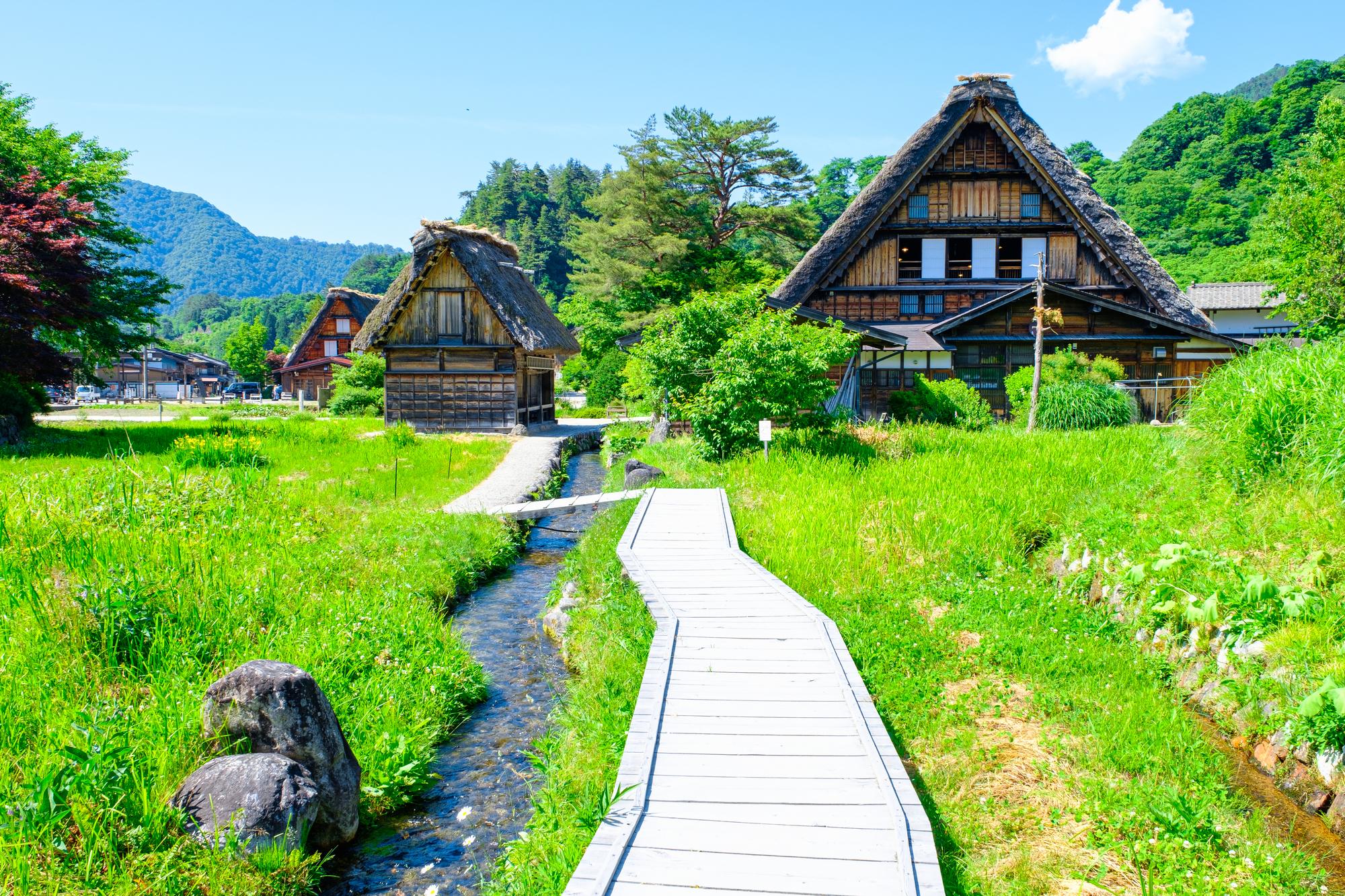
Shirakawa-go's 114 gassho-zukuri farmhouses—steep thatched roofs engineered to shed three metres of annual snowfall—were built without nails between the 17th and 19th centuries. The village earned UNESCO World Heritage status in 1995 alongside neighbouring Gokayama, preserving a construction method that once dotted the Shogawa River valley. Today, nineteen farmhouses remain inhabited year-round, their multi-generation families maintaining sericulture attics and irori hearths that have burned for two centuries. The settlement sits 500 metres above sea level in the Shokawa basin, ringed by the Ryohaku range to the west and Mount Hakusan's 2,702-metre summit to the east. Winter isolation shaped the architecture: 60-degree roof pitches, bound with wisteria vine and weighted by straw thatch replaced every thirty years, created self-supporting triangular frames that bear snow loads exceeding 400 kilograms per square metre. The interiors functioned as vertical factories—ground-floor living quarters, mezzanine silk cultivation, attic storage—all heated by a single sunken hearth. A nagoya to shirakawago private tour typically departs central Honshu at 08:00, crossing the Nobi Plain and ascending through Gujo and Takayama. The 140-kilometre journey traces Route 156 along the Nagara and Sho rivers, climbing past terraced rice paddies and cedar forests. Arrival between 09:30 and 10:00 allows two hours in Ogimachi village before midday tour buses dominate the observation deck. The Wada House, Shirakawa-go's largest farmhouse at 300 years old, opens its five-storey interior to visitors. Original tatami mats, blackened ceiling beams, and sericulture trays document Edo-period mountain life. The Myozenji Temple complex, reconstructed in 1748, houses 200-year-old gassho structures relocated from surrounding hamlets. Fifteen farmhouses operate as minshuku guesthouses, serving hoba miso and mountain vegetable kaiseki under exposed rafter systems unchanged since the Tokugawa shogunate.
"The 60-degree roof pitch—bound with wisteria vine and weighted by thatch—bears snow loads exceeding 400 kilograms per square metre."
A step-by-step walkthrough of the visit — what you'll see, how long each stage takes, and the details that matter.
You board your private transfer in Nagoya's Meieki district at 08:00, the vehicle climbing northwest through the Nobi Plain as the Kiso River valley opens below. By 09:45 you cross into Gifu Prefecture, the road narrowing past Takayama's preserved merchant quarter. The first gassho roofs appear through morning mist—triangular silhouettes against forested ridges. You step into Ogimachi at 10:15, the village spreading across a terraced bowl carved by the Sho River. Gravel paths wind between farmhouses, their thatched profiles leaning at identical angles. You enter the Wada House's ground floor, ducking beneath a lintel worn smooth by three centuries of hands. The irori hearth radiates residual warmth; soot coats the overhead beams in a glossy black patina. Narrow stairs lead to sericulture platforms where mulberry leaves once fed ten thousand silkworms. You climb the eastern hillside footpath to the Shiroyama observation deck, 140 metres above the village. The gassho roofs align in geometric rows, their ridge poles parallel to the prevailing winter wind. Rice paddies fill the gaps, reflecting clouds in shallow water. You descend through persimmon orchards and cross the suspension bridge spanning the Sho, the planks swaying under your weight. By 12:30 the parking lots fill with tour buses; you return to your vehicle as the midday crowds arrive.
Shirakawa-go is open from 08:00–17:00 daily, fitting your nagoya to shirakawago private tour schedule perfectly.
Entry to the village is 0 JPY, though individual facility fees apply during your visit.
Arriving between 08:00–10:00 is recommended to avoid peak crowds for your nagoya to shirakawago private tour.
While the village is open to the public, paths can be steep and uneven for those on a private tour.
Yes, photography is welcome in public spaces, but please respect private property and residents.
Yes, various local food stalls operate during your nagoya to shirakawago private tour.
Prohibited items include drones, open flames, and smoking to protect the heritage village.
Coin lockers are located near the main entrance to store luggage during your nagoya to shirakawago private tour.
Cancellations 24 hours in advance allow for a full refund of your nagoya to shirakawago private tour tickets.